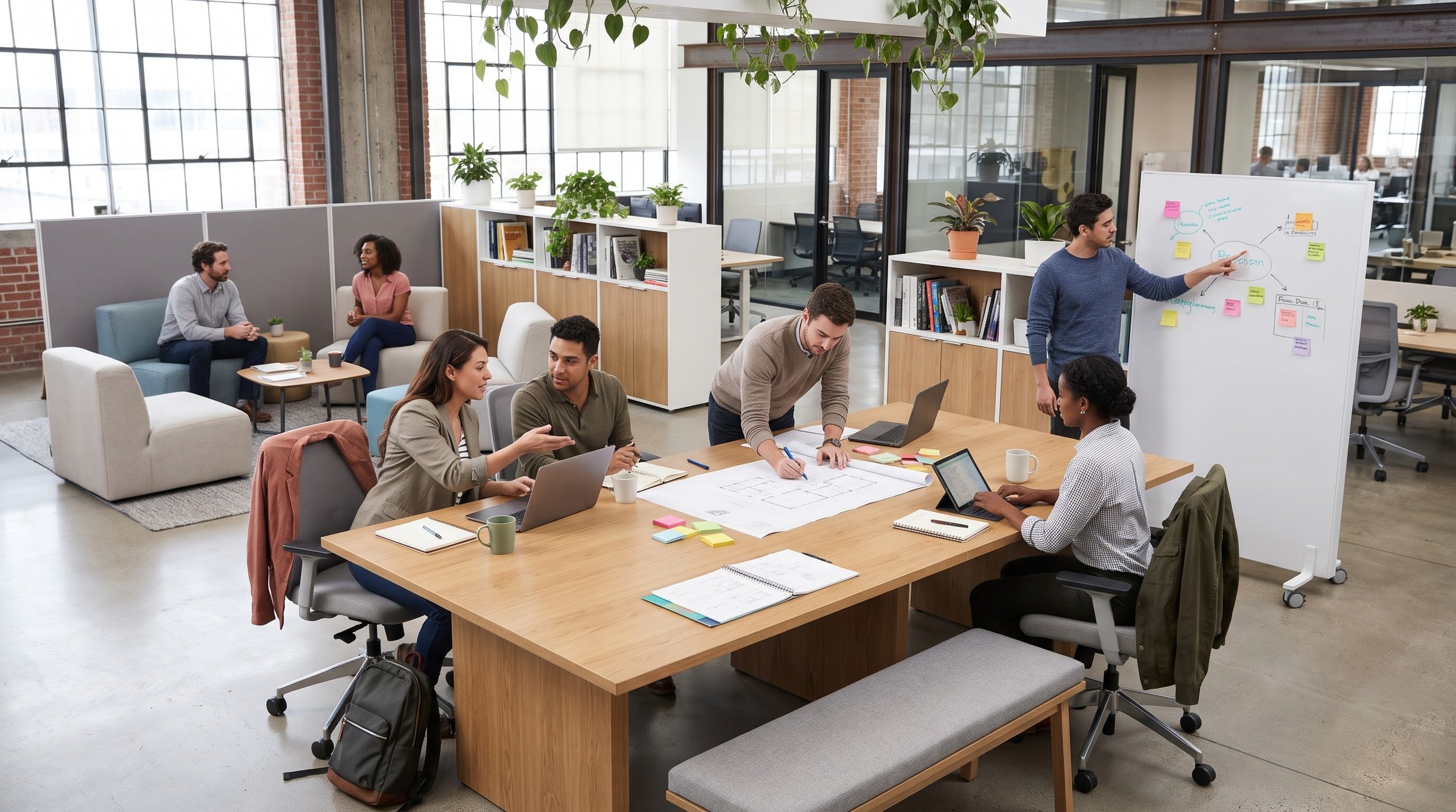
A productive office needs more than individual desks and ergonomic chairs. Employees also need spaces where they can exchange ideas, work through projects, hold informal discussions, and collaborate with colleagues.
The furniture selected for these areas plays an important role in determining how people use the space. A large conference table may support formal meetings, while modular seating and smaller tables can encourage more casual interaction.
As workplace expectations continue to change, businesses are reconsidering how their offices accommodate different activities. According to Gensler’s 2026 Global Workplace Survey, approximately two-thirds of surveyed office workers adapt their workspaces to compensate for design shortcomings. The survey also found that 65% use meeting rooms for individual focused work, 60% hold meetings at their desks, and 64% take calls in hallways or stairways. These behaviors point to an opportunity to create more purposeful spaces with appropriately selected furniture.
Here are some ways to furnish collaborative office areas that support different working styles.
1. Create Different Types of Collaboration Areas
Not every workplace discussion requires a formal conference room. Some conversations are brief and informal, while others involve larger teams and more structured activities.
Instead of relying on one meeting-room arrangement, consider creating different collaborative zones throughout the office.
For example:
Small tables for quick team discussions.
Lounge seating for informal conversations.
Communal tables for shared project work.
Conference tables for scheduled meetings.
High-top tables for short standing discussions.
Providing a variety of furniture arrangements allows employees to choose spaces that suit the task at hand.
2. Use Modular Furniture for Flexible Arrangements
Modular furniture is especially useful in offices where rooms need to accommodate different group sizes and activities.
Movable tables, lightweight chairs, modular sofas, and reconfigurable seating can make it easier to transform a space without undertaking major construction.
A meeting area might function as a small discussion space in the morning and accommodate a larger workshop in the afternoon.
Consider selecting furniture that:
Can be rearranged without specialized equipment.
Is lightweight enough for employees to move safely.
Can be combined into different configurations.
Includes integrated power or cable-management options where needed.
Maintains a consistent appearance across different arrangements.
The data behind the design: Gensler’s 2026 Global Workplace Survey identifies the ability to rearrange meeting-room furniture as one of the design attributes associated with employees viewing their workplaces as more effective for learning. Flexible furniture can therefore support more than space efficiency; it can help create environments that adapt to different forms of collaboration.
3. Select Tables That Support Different Activities
The table is often the central piece of collaborative furniture. Its size and shape should reflect the activities taking place around it.
A large rectangular table can support structured meetings, while round tables encourage face-to-face interaction among smaller groups.
Other options include:
Flip-top tables that can be stored or rearranged.
Nesting tables for flexible group configurations.
Communal worktables for shared projects.
Standing-height tables for short discussions.
Mobile tables for multipurpose rooms.
Consider how many people will regularly use the area and whether employees need space for laptops, documents, presentations, or shared equipment.
The right table should accommodate the activity without making the room feel overcrowded.
4. Introduce Comfortable Seating Beyond Traditional Meeting Chairs
Collaborative spaces do not always need to look like conventional conference rooms.
Upholstered lounge chairs, modular sofas, benches, and occasional chairs can create a more relaxed setting for informal discussions and brainstorming sessions.
However, comfort should not come at the expense of functionality. Seating should support the expected duration of use, allow people to communicate comfortably, and provide enough space for movement.
For longer meetings, supportive chairs with appropriate backrests may be more suitable than low lounge seating. For informal conversations, softer seating arrangements can help make the space feel less rigid.
5. Incorporate Furniture That Supports Technology
Modern collaboration often involves more than face-to-face conversations. Employees may need to connect laptops, display presentations, join video calls, or share digital documents.
Furniture should make these activities convenient.
Consider meeting tables with integrated power access, cable-management solutions, monitor stands, and mobile presentation carts.
For smaller collaborative areas, compact side tables with accessible charging points can be useful.
Technology should be integrated into the furniture plan rather than added as an afterthought. This helps minimize visible cables and keeps shared work areas organized.
6. Use Furniture to Define Spaces Without Building Walls
Open-plan offices often need ways to distinguish collaborative areas from individual workstations.
Furniture can help establish these boundaries without requiring permanent partitions.
For example:
Modular sofas can define informal lounge areas.
Bookcases can provide storage while creating visual separation.
High-backed seating can offer a greater sense of enclosure.
Shared tables can establish a dedicated project area.
Mobile screens can provide temporary privacy when needed.
This approach allows businesses to create distinct zones while preserving flexibility and maintaining a sense of openness.
7. Choose Durable Materials for High-Use Areas
Collaborative furniture is often shared by multiple employees throughout the day. As a result, durability and maintenance should be important considerations.
Select surfaces that are easy to clean and resistant to everyday wear. Upholstery should be appropriate for frequent use, while table finishes should withstand laptops, stationery, food, and regular handling.
Consider materials such as:
Commercial-grade laminate for frequently used tables.
Durable wood finishes for warmth and visual character.
Performance upholstery for shared seating.
Metal frames for structural support.
Replaceable components where practical.
The aim is to balance longevity with a design that feels welcoming rather than overly institutional.
8. Make the Furniture Arrangement Easy to Navigate
Even well-selected furniture can become a problem if it is arranged without considering circulation.
Collaborative areas should provide enough room for employees to enter, move between seats, pull out chairs, and access shared equipment.
Avoid placing large tables too close to doorways or using oversized sofas that restrict circulation.
Consider the relationship between collaborative areas and nearby workstations, meeting rooms, and shared facilities. Noisy discussion zones should be positioned thoughtfully so they do not unnecessarily interrupt employees who need to concentrate.
Why This Matters
Collaborative spaces should make it easier for employees to connect without creating additional obstacles in the workplace.
Gensler’s 2026 Global Workplace Survey highlights a mismatch between how employees use offices and how some spaces are designed. When 65% of surveyed workers use meeting rooms for individual focused work and 60% hold meetings at their desks, it suggests that existing workplace settings may not always accommodate employees’ actual needs.
A more intentional furniture plan can help businesses make better use of available space by providing dedicated areas for group discussions, focused work, and informal collaboration.
Final Thoughts
A collaborative office is not defined by how many meeting tables or lounge chairs it contains. It is defined by how effectively its furniture supports the people and activities within it.
At West Village Interiors, we believe commercial furniture should be selected with flexibility, durability, and the employee experience in mind. Through thoughtful furniture choices and adaptable layouts, businesses can create collaborative environments that feel cohesive, comfortable, and ready to support the way teams work.